
Insider tips for travellers on the marketplace of research treasures
Good documentation is key to making research transparent, reusable and verifiable. This section offers practical advice for sharing and using open materials, data and code effectively – whether you’re contributing your own work or building on existing resources.
Providing open data, materials and code
Practical tips for making your research outputs findable and usable:
- Remember mum’s unwavering trust in the secure neck pouch when travelling? If security and fast availability are also essential for your research, store your data in a publicly accessible repository such as OSF (Open Science Framework) or Zenodo. Make sure that the platform assigns DOIs (Digital Object Identifiers) so that your data can be cited.
- Use open formats such as CSV instead of Excel – just as a universal travel adapter enables easy connection to any power grid. Your data should also be compatible and usable for other researchers. Use R, Python or Jupyter Notebooks for scripts and analyses to ensure transparency.
- Do you love marketplace apps? Your colleagues all do too! A well-structured README file helps others to find their way around quickly. Document it:
- Content of the files (e.g. questionnaires, stimuli, data sets)
- Software and versions used
- Notes on reproducing the analyses
- Personal data must be removed or pseudonymised before publication. If full disclosure is not possible, access conditions should be clearly stated.
- Use Creative Commons licences (e.g. CC-BY or CC-BY-NC) to clarify how your data may be used.
- Use detailed comments in your code and test whether it runs on other systems. Version control systems such as Git help to track changes.

Using open data and materials
Key points to keep in mind when working with existing research data:
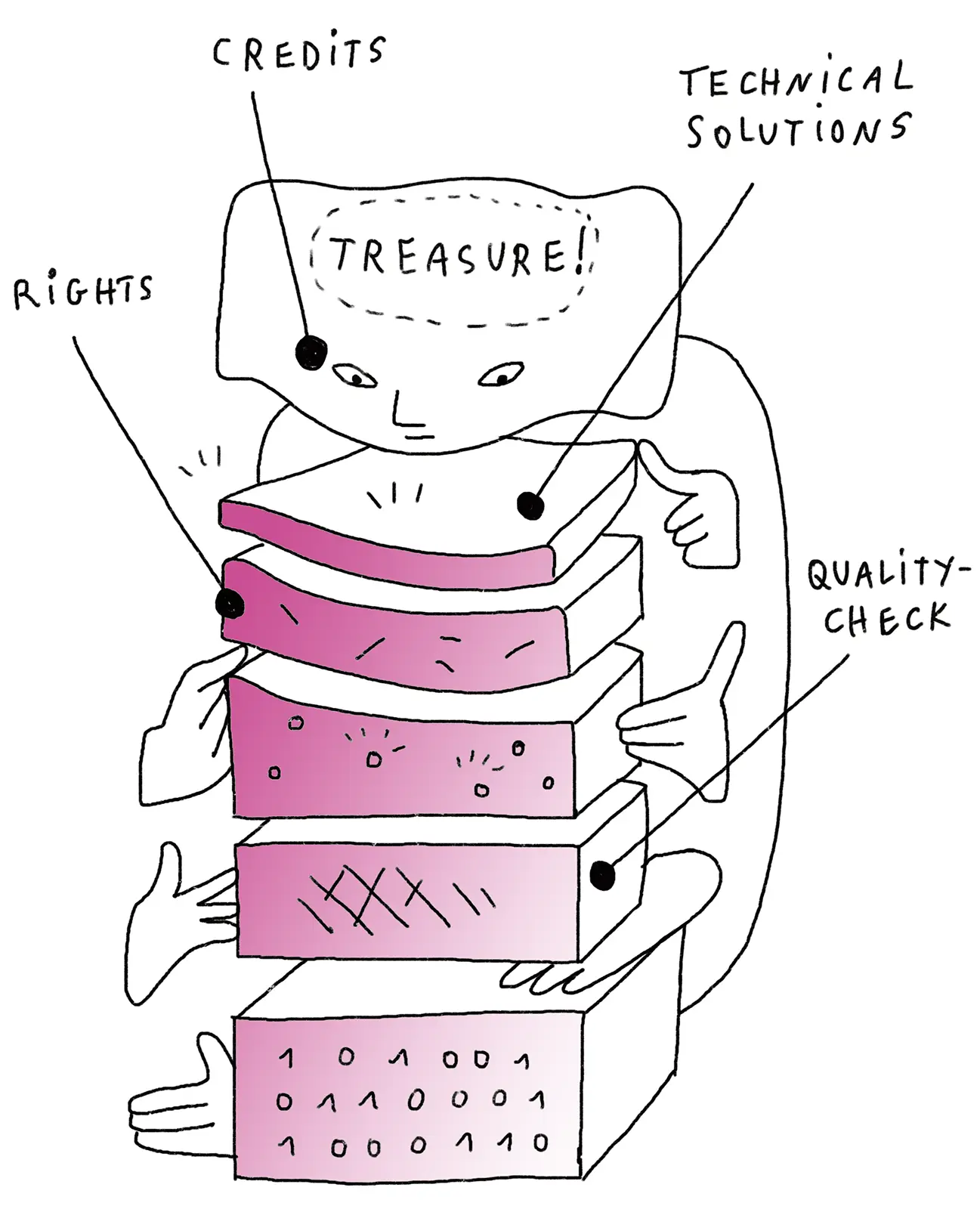
- Make sure that the data comes from reliable repositories and has a DOI. Read the associated documentation in order to interpret the data correctly.
- If you cannot work with certain formats, convert them to common standards (e.g. CSV, JSON for structured text).
- Check the conditions under which the data may be used. Many open data sets allow subsequent use, but require a source reference.
- Use questionnaires, experimental stimuli or analysis methods that are already available to build your own studies on – instead of developing everything from scratch.
- If you use open data, give original authors the credit they deserve. Proper citation of datasets increases their visibility and encourages others to share.
Further Reading
For those who want to explore the topic in more depth
Deer, L., Adler, S., Datta, H., Mizik, N., & Sarstedt, M. (2025).
Toward Open Science in marketing research. International Journal of Research in Marketing, 42(1), 212-233.
https://doi.org/10.1016/j.ijresmar.2024.12.005
Wilkinson, M. D., Dumontier, M., Aalbersberg, I. J. J., Appleton, G., Axton, M., Baak, A., Blomberg, N., Boiten, J.-W., da Silva Santos, L. B., Bourne, P. E., Bouwman, J., Brookes, A. J., Clark, T., Crosas, M., Dillo, I., Dumon, O., Edmunds, S., Evelo, C. T., Finkers, R., . . Mons, B. (2016).
The FAIR guiding principles for scientific data management and stewardship. Scientific Data, 3, Article 160018.
https://doi.org/10.1038/sdata.2016.18